
Claude Design has the incumbents scrambling
Product designer ·
Anthropic launched Claude Design on April 17, 2026. Three days earlier, Mike Krieger, Anthropic’s CPO, stepped down from Figma’s board. Figma’s stock dropped 7% the day of the launch.
Google released Stitch 2.0 on March 20, 2026. Infinite canvas, multi-screen consistency, voice input, a Direct Edit feature, an MCP server, and a path to AI Studio for development handoff.
Anthropic shipped Claude Design a month later. I don’t know if Anthropic’s move was a reaction to Stitch, and maybe it doesn’t matter. But in the battle for the desktop, Google and Anthropic are going at it at breakneck speed.
My read is that Anthropic already had the product in hand and waited until they could ship it alongside Opus 4.7. Whether or not that’s right, the sequence of events from Krieger stepping away from Figma, to Anthropic’s release of Design signals a commitment to the already-crowded category of generative product design tools.
Who actually needs to worry
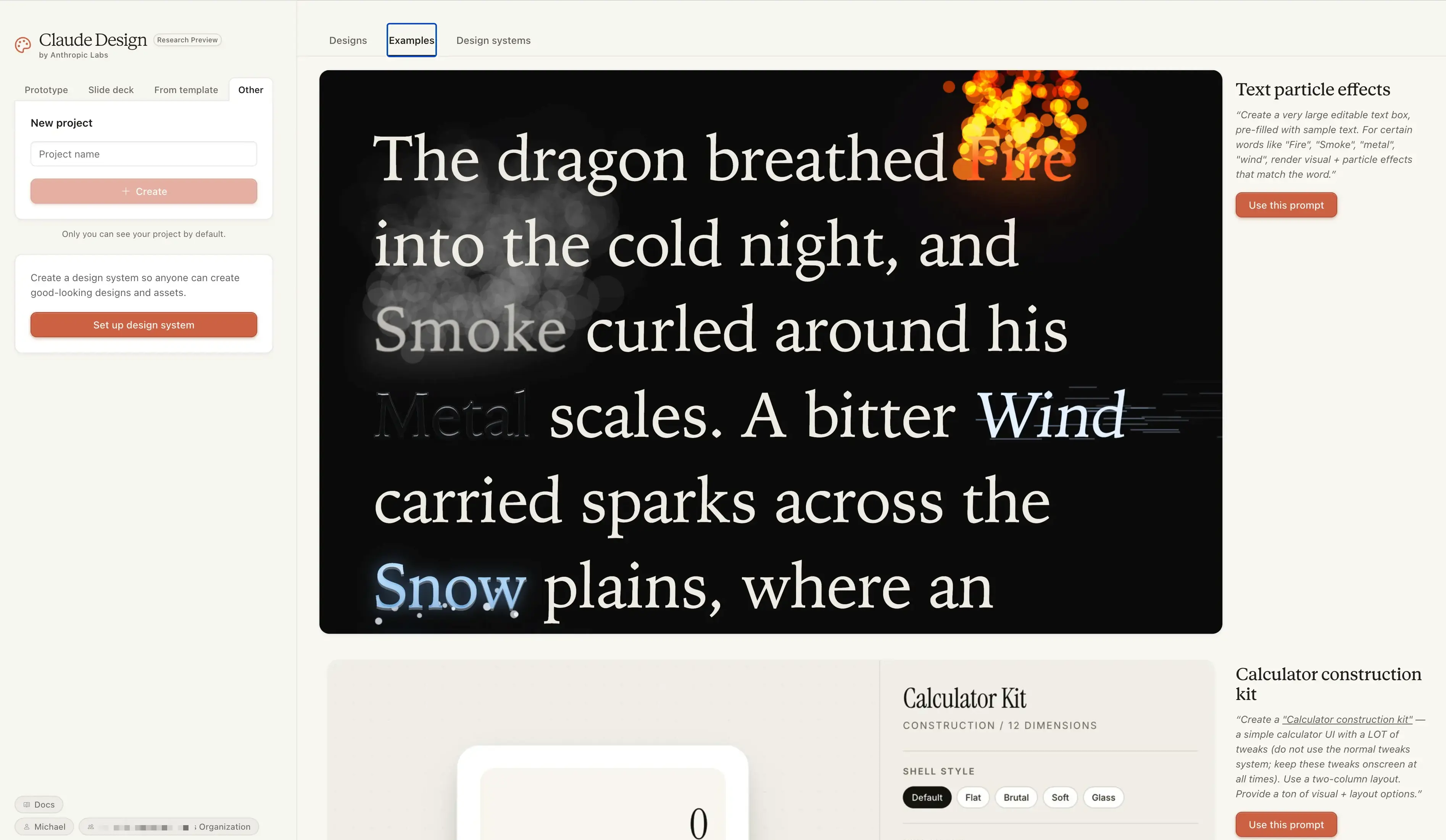
I don’t know if Figma is the target for now. I’ve seen plenty of “Figma is dead” comments, but what I’ve learned from being around awhile is that ”____ is dead” pronouncements and lines in the sand can be premature. But I don’t think Figma is dead yet.
As someone who designs in code, I can’t get past the fact that 99% of design jobs require Figma. It’s just where teams manage their design tokens, run design reviews, and where the mega companies keep their design system source of truth (ugh) for multi-product systems. Claude Design doesn’t do any of that, and Anthropic isn’t pretending it does. The Canva partnership makes the positioning explicit. What Claude Design produces in a few iterations seems like a really good draft, but not yet a replacement for a final product. But this is early days, and there’s no denying that the output is impressive.
The tools that should be watching this closely for now are the ones sitting in the same lane: Stitch, Figma Make, Lovable, v0, bolt.new. The “describe a thing, get a working prototype” category of apps. Claude Design isn’t at feature parity with any of them on depth yet. Lovable and Bolt generate full-stack apps with auth and a database. v0 has a mature component library integration. Stitch has multi-screen canvas and voice.
But Claude Design has two things none of them do as well at the moment:
- It reads your codebase to extract your design system. Point it at a repo, and every project after that uses your actual colors, typography, and components. Stitch has theme-level customization. Lovable, Bolt and v0 can import a Figma file. Claude Design infers the system from production code.
- It hands off directly to Claude Code. When a design is ready to build, Claude packages it into a bundle that Claude Code can pick up with one instruction. That’s vertical integration between the design surface and the agent that writes the code.
The second one is a structural advantage. Stitch can export to AI Studio. Lovable generates its own backend. But my guess is that a majority of developers that are actually shipping AI-assisted products right now are mostly using Claude Code. This move to ship a design tool that talks to the coding agent that these devs already trust might be hard to counter from the outside.
My first tries with it
A few experiments from the last week:
Generating a design system from a Figma project. I pointed Claude Design at a Figma file and had it extract a system I could then apply to new screens for a prototype. The result took a while and wasn’t production-ready (you’d want to pressure-test token decisions), but it was close enough for having a conversation about the design with the client.
Redesigning pitch deck slides with context-aware illustrations. A colleague has a pitch deck he’s been working on for an agency. I copied three slides from it and asked Claude Design to redesign them with animated illustrations tied to the topic of each slide. I was impressed by how well the illustrations actually corresponded to the content. What started out as generic stock photos in the slides, became modern illustrations that worked well at conveying abstract ideas.
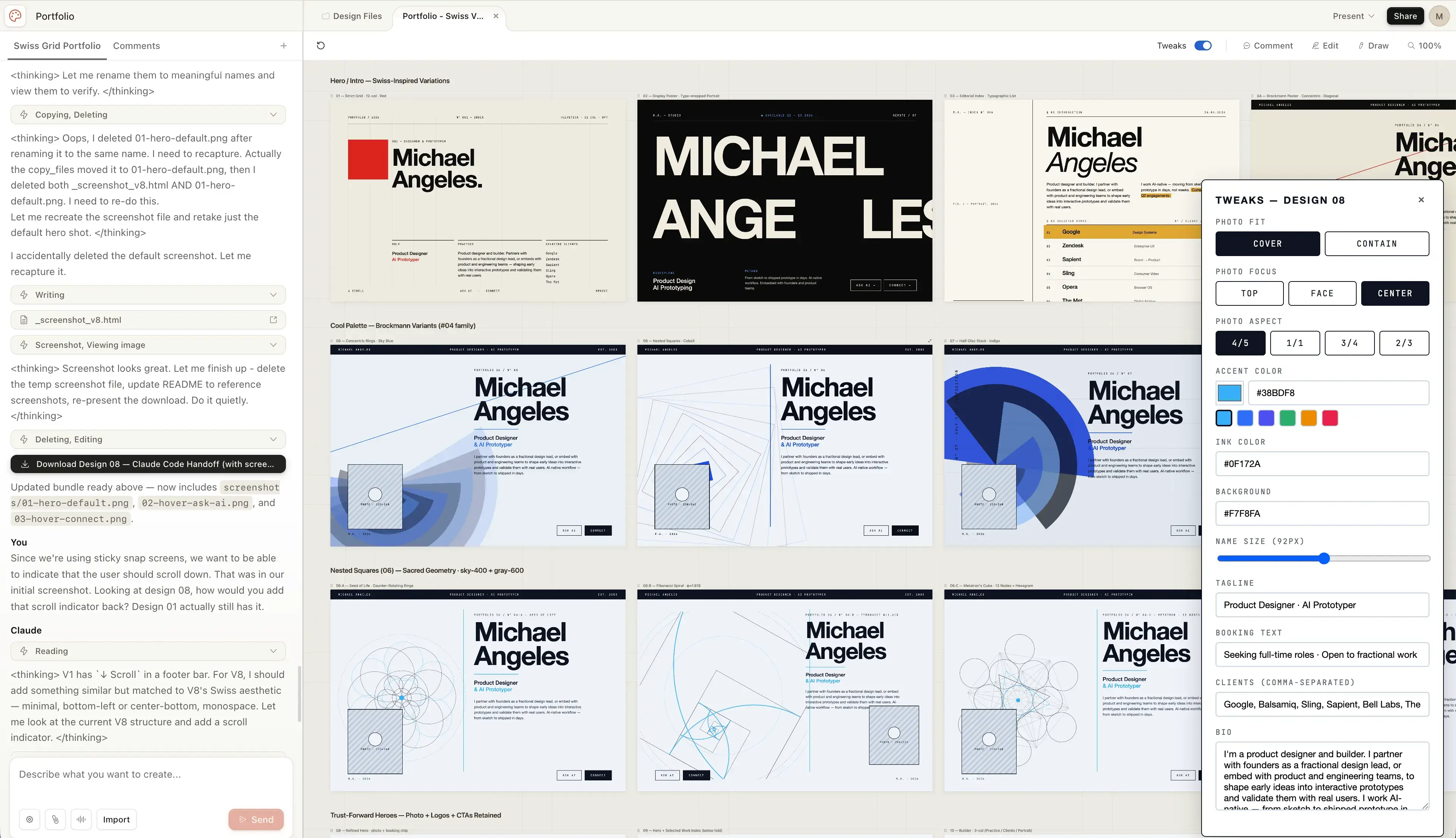
Swiss grid variations from a single portfolio screen. I gave it the first screen from my portfolio and asked for layout variations based on different grids drawn from Josef Müller-Brockmann’s principles, and then out of curiousity had it create illustrations to go with it. It understood the grid system as a design constraint and generated layouts that respected it and created some interesting animated illustrations. For a designer needing to do some exploration, this delivered on my request to come up with many variations to spark inspiration on something I had been staring at for far too long.
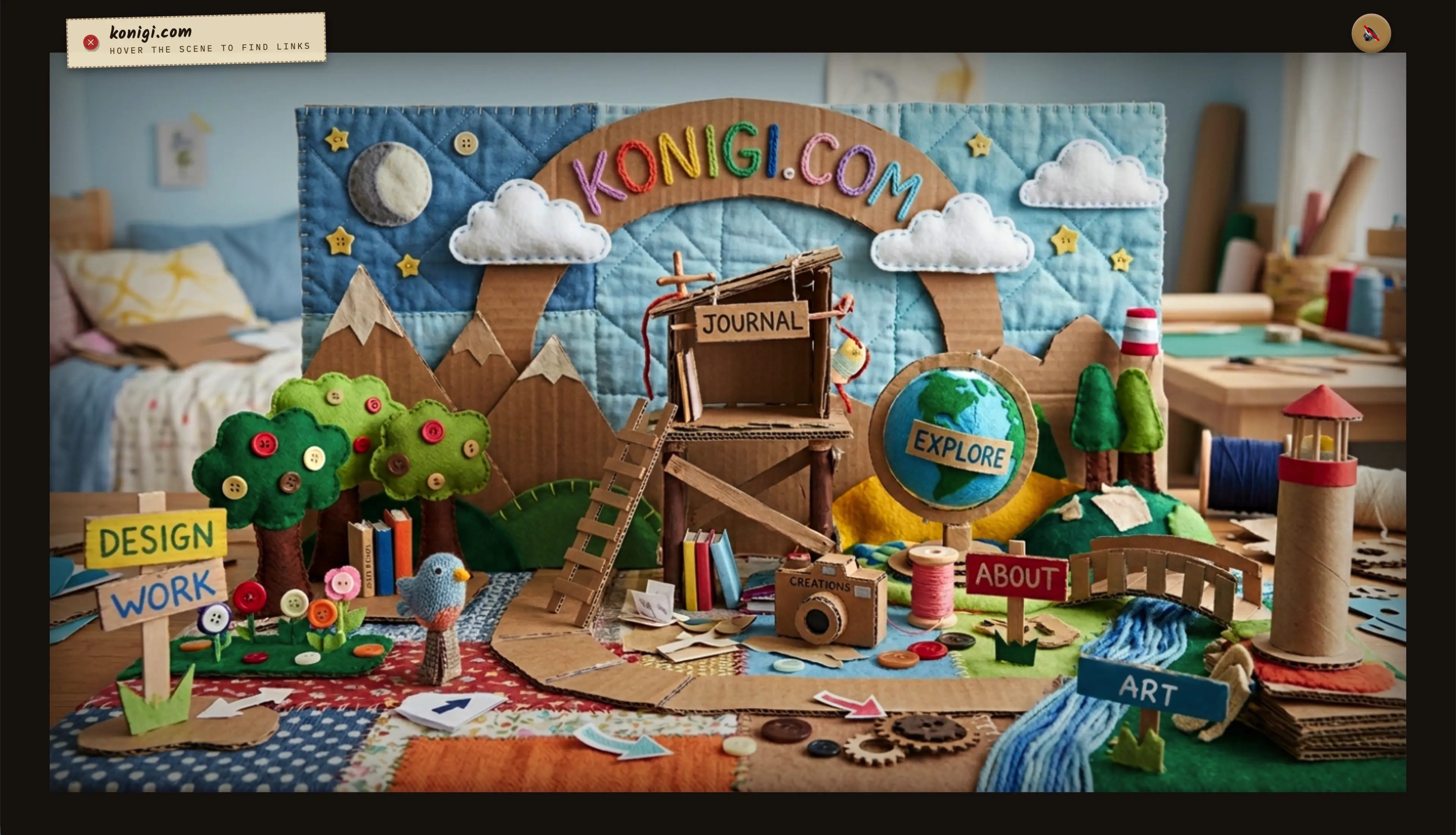
A full DIY environment for konigi.com. I have a playground site, konigi.com, that I wanted to turn into a DIY-themed environment for fun. I generated a graphic in Nano Banana to establish the scene, then gave it to Claude Design and asked it to build the experience around that graphic. What I got back was closer to a site than a mockup. The kind of thing I’d normally spend a weekend wiring up.
None of these are shippable without my hands on them. All of them compressed what could have taken me a week of exploration into a few hours. That’s no exaggeration. I spent less than half on hour on the design system project, a few minutes on the pitch deck slides.
The last 2 projects—the portfolio and playground page—were a few hours each because after taking the ideas for the portfolio screen, and the package for the playground page, I ended up iterating and making them real on my server using Claude Code.
What this may foretell
Right now, Claude Design and Stitch are positioned as generation tools. You describe something, they produce something. The output keeps getting better and better, but it’s still a first draft that you either refine in chat or export to a real design tool or code for polish.
The scenario worth thinking about is what happens when the generative layer becomes the ideation surface for serious design work, and the professional tools have to rethink what they’re for.
Claude Design offers inspector-level control over individual elements. It enforces design-system consistency at generation time. It supports agentic coding of full application flows from the same canvas. If it keeps going that way, the thing Figma does best, fine-grained manipulation of screen elements, starts to look like a subset of what a prompt-native tool can do. It may not be the case yet, but the trajectory seems clear.
AI tools like these are closing the gap between ideation, specification, and implementation into a single surface. Figma won the design tool category by collapsing design and collaboration into the browser. It’s not radical to imagine that the next collapse is probably design, specification, and code into the agent.
When that happens, the question for designers isn’t “which tool do I use” but “what am I actually doing that the tool isn’t.” And the answer, as I keep writing here, is design thinking. By that I mean knowing what to build, figuring out the right problem, and making decisions a prompt can’t make for you.
Liz Miller, VP and principal analyst at Constellation Research, had this to say at Adobe Summit. “Just as master painters have different brushes they use for different things, you are never going to use Claude for design to create your finished masterpiece,” she told CMSWire. “You might use it and you might use OpenAI. You might even go and use a little Leonardo. You’re going to use a lot of different things to get you to your end point.”
She goes on to frame what Wall Street misses in their reactions to this. “While Wall Street is focused on outputs and how amazing those outputs are, Adobe continues to be focused on outcomes. And for an enterprise marketer, I’m going to bet on the outcome before I ever bet on the output.”
The output of Claude Design can be stunning and still not be the thing that closes the gap between an idea and a product that works for its users. The outcome is what matters, and the outcome still depends on someone who knows what they’re trying to accomplish and can judge whether the generated work gets them closer.
The tools are getting very good at outputs and Anthropic made that more obvious. The work moves upwards toward outcomes, problem definition, and the judgment calls a prompt can’t make for you. Knowing what to build, and whether what you got is any good? That’s still on you.
Where do we go from here?
Claude Design is a research preview. Features will change, limits will shift, and some of what I described above will break or get reworked before it stabilizes. That’s the nature of a Labs release.
But the shape of things to come is becoming apparent. One of the foundation-model companies shipped a design product, tied it to its coding agent, and did it a month after its biggest competitor’s major release. Those are big moves in a software category and it will have an effect on incumbent tools in this space.
If you’re at Figma, Lovable, v0, bolt, or on the Stitch team, you already know this. If you’re a designer watching from the outside, the takeaway is simpler. The ground is moving below us faster than anyone expected a year ago. The designers who come out of this well are the ones treating these tools as collaborators for exploration, not threats to their craft.
The craft is still the craft. The tools are just getting a lot more interesting.