
How to Get Your Site Cited by AI: A GEO field guide
Product designer ·
People stopped scrolling through links. They ask ChatGPT, Claude, or Perplexity a question, read the single answer it gives back, and move on. Bain found that 60% of searches now end without a click. If your content isn’t in that answer, it may as well not exist. Getting cited is work you can do. Here’s how.
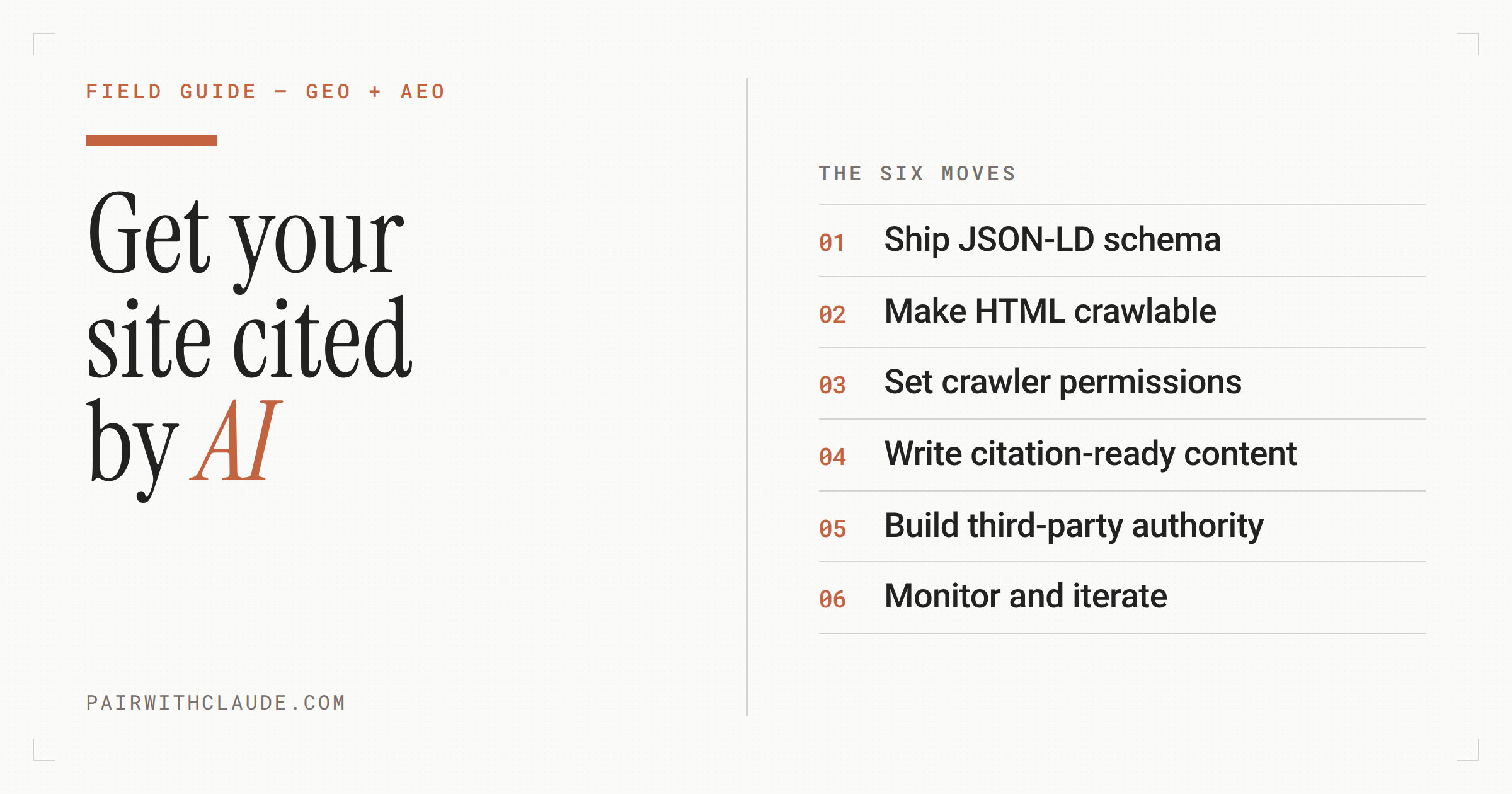
The practice of optimizing your site content for AI is called AEO (AI Engine Optimization) or GEO (Generative Engine Optimization), depending on who you ask. AI assistants like ChatGPT, Perplexity, Gemini, and Claude are increasingly where people go for answers, and those systems don’t work like search engines. They pull from a different pool of signals. If you only think about Google, you’re not optimizing for these new search behaviors.
Since pairwithclaude.com is a new site, I have some work to do to optimize it for AI engines, so that people looking for answers related to AI-assisted design in their LLMs might find answers here. Here’s what I did and what the limits of this kind of work are.
What AI engines need that Google doesn’t
Search engines rank pages. Google cares about backlinks, page speed, and keyword density.
AI engines synthesize answers from sources they trust. AI engines care about clarity, structured data, and whether there’s enough context to understand who wrote something and why they’re credible. They also care about what’s been published about you elsewhere on the web.
A site can rank well on Google and still be invisible to AI engines, and vice versa. This site at the time of writing is in the first camp. There’s nothing that helps AI systems understand who writes here, what I know, or how articles connect to each other.
There’s also a shift in what success even looks like now. With SEO, the goal is a click. Someone sees your result and visits your site. With GEO, an AI generates the answer and the user may never visit at all. They got what they needed inside the AI interface. That sounds like a loss, but it isn’t necessarily. The citation still happened, the brand was still mentioned, and the user’s picture of who knows this topic now includes you and your site. The reality is that you have to optimize for presence in the answers.
The mechanical work: JSON-LD and Byline
JSON-LD
The first thing to do to is add JSON-LD structured data. This is machine-readable metadata embedded in page <head> tags.
I added three schemas in a script tag embedded in the head:
- A
WebSiteschema appears on every page — it names the site, describes it, and links to the author. - An
Articleschema appears on every article page — it names the piece, credits the author with job title and areas of expertise, and gives the publish date. - A
Personschema on the/aboutpage fills out the author profile: what I know, what I’ve written, what my professional background is.
Looks like this:
<script type="application/ld+json">
  "@type": "Article",
  "author": "Your Name",
  "datePublished": "2026-05-21"
</script>
None of this is visible to readers. It’s entirely for crawlers and language models. It answers the questions AI systems ask when deciding whether to cite a source, e.g. who wrote this, do they know what they’re talking about, and is this current?
Author byline
I also added an author byline to every article, beneath the title.
Signed content is more likely to be treated as authoritative than anonymous content. The byline is an E-E-A-T signal (experience, expertise, authoritativeness, trustworthiness), a framework Google uses and that AI engines appear to apply in their own ways.
LLMS.txt?
I’ve seen conflicting information about the use of llms.txt files. This is a plain-text file at the root of your site that tells AI crawlers what the site is about and where to find the content, like a README for language models. It could list the site’s purpose with links to every published article with a one-line description, and point to the about page and RSS feed. Doesn’t seem harmful to add, so I did it, also adding llms-full.txt using the same structure, but with the full text of every article appended, giving AI engines the actual content to work from without having to crawl individual pages.]
Key takeaways and clarity
The mechanical stuff is table stakes. The harder part is writing in a way that’s easy for AI to summarize accurately.
AI engines don’t cite articles they can’t summarize. If your ideas are buried inside long sections with weak headers, the model can’t pull a clean answer from your content. The inverse is also true: if your article is a tight, well-structured piece with clear section headers and a direct argument, it’s much easier for a model to reference it accurately.
I added a Key Takeaways block to each article. It includes three or four sentences summarizing the main points. You can see an example at the bottom of this article.
Key Takeaways are like the executive summary at the top of a long report. Not everyone will read everything, and the people (or systems) who skim need a reliable shortcut to the argument.
The takeaways also give AI engines something explicit to quote. Instead of having to synthesize meaning from 800 words of prose, they have direct bullets that represent the author’s own summary of what matters.
There’s some research behind this. The GEO-BENCH study from Princeton, Georgia Tech, Allen Institute for AI, and IIT Delhi tested optimization strategies across 10,000 queries in 25 domains. Their findings: quotations boost AI citation rates by 41%, using real statistics by 32%, including citations to authoritative sources by 30%, and clear writing by 28%. A separate analysis found that cited content has roughly 20.6% entity density—proper nouns, brand names, named people, specific products— compared to 5–8% in standard English. Being specific isn’t just clearer. It’s measurably more citable.
What on-site work can’t do
Everything above gets you ready to be cited, but doesn’t make your words citable. I’m in that position right now. Writing content on a new topic in a new, undiscovered site (or blog if you will) won’t necessarily make for appropriate answers to what’s being asked.
AI engines build their understanding of authority from what’s been published about you, not just from what you’ve published about yourself. A site with perfect structured data and no external mentions is a well-formatted unknown. A site with rough technical SEO but lots of credible third-party references will show up in AI-generated answers because the training data has already absorbed those signals.
This is the part that takes time and can’t be engineered in one sitting. Speaking at events, writing for other publications, being quoted in articles, getting your work shared and linked by people with established reputations—these are the kinds of signals that will most likely tell AI systems a source is worth trusting. On-site optimization creates the infrastructure for authority, and third-party mentions are the authority itself.
How do you know if it’s working?
This is going to be the hard part I guess. There’s no Perplexity Search Console and you can’t see your citation rate the way you can see organic traffic. But companies like AthenaHQ are trying to solve this problem for brands.
The proxies I’m using for now:
- Ask AI assistants about topics I write about and see if the site comes up.
- Watch for direct mentions in AI-generated content that gets shared.
- Check referral traffic for unusual sources.
I know this isn’t precise. It’s mostly hygiene work for now. It’s the kind of thing that matters and will pay over time. The structured data is baked into the site and updates automatically as new articles publish. The writing habits, clear structure, explicit takeaways and signed bylines will make the content better for human readers too.
Optimizing for AI and optimizing for readers are the same work. Make your content clearer. Anyone who publishes should review their content now, or risk going invisible as people switch to AI search.